https://www.bbc.co.uk/news/articles/cy5dz0kkn0wo
When a state crosses an international border with sovereign military hardware to obliterate fuel depots, logistics hubs, and industrial infrastructure deep within another nation, it is an act of war. It is not semantic semantics. It is not a defensive posture. It is active co-belligerency attack, plain and simple.
Yet, watch how the institutional apparatus spins to launder reality.
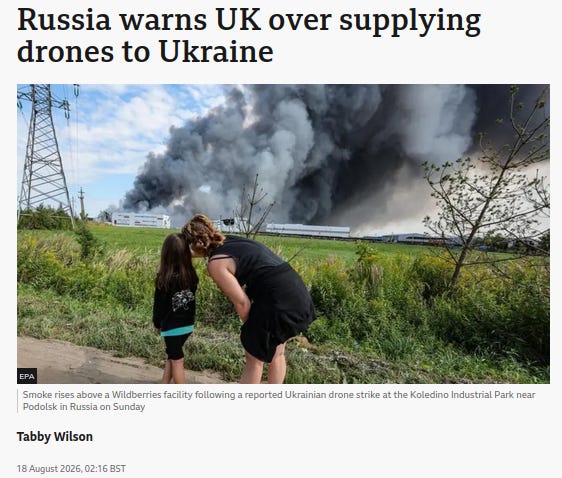
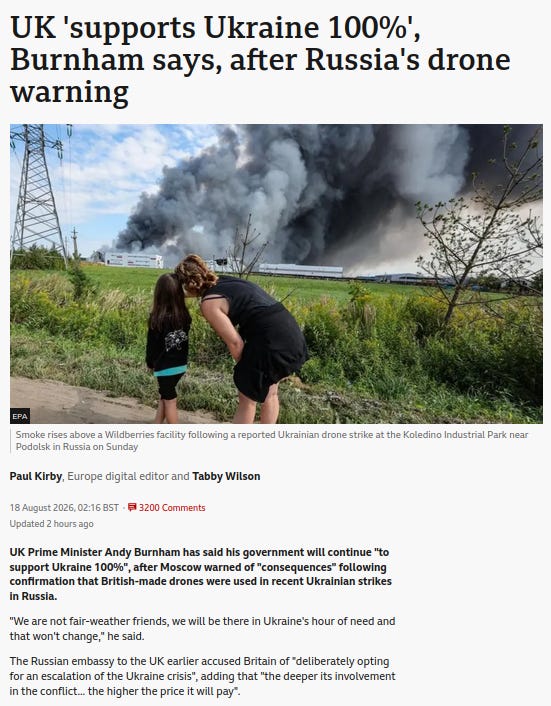
In its coverage of the recent escalation—highlighting British-made drones deployed inside Russia causing massive infrastructural destruction—the state-aligned media machinery systematically strips away objective definitions. Downing Street stands behind podiums declaring that the UK stands "100% behind" an escalating campaign, while journalists dutifully parrot the line that crossing foreign airspace to wage industrial sabotage constitutes "self-defense."

https://www.bbc.co.uk/news/articles/cy5dz0kkn0wo
Let us be entirely clear about the mechanics of this linguistic sleight of hand:
The Physical Reality: Offensive weaponry is launched across an international boundary to destroy sovereign infrastructure.
The Institutional Narrative: The act is reframed as a passive shield, as if dropping explosives onto a distribution hub near Moscow or a logistics center is somehow structurally equivalent to holding a line in a trench.
This is the core pathology of modern institutional reporting. By adopting the framing of the aggressor-supporter coalition, the media acts as a willing transmission belt for escalation. It sanitizes the descent into total war by wrapping offensive combat operations in the comforting blanket of defensive necessity.
When international borders are breached with state-supplied munitions, you are no longer a neutral observer or a distant benefactor; you are an active co-belligerent and an aggressor in a widening conflagration. Pretending otherwise isn’t just poor journalism—it is a deliberate obscuring of the precipice we are being marched toward.
Fedorov criticised bureaucracy in the UK and other countries supporting Ukraine for delays in supplying weapons.
The UK is a longstanding supporter of Ukraine, spending £16bn supplying weapons since the war began. It was confirmed last week that British-made drones have been used to attack Russian targets…
Fedorov urged direct funding of the latest Ukrainian drone production, in place of outdated skills and equipment from other nations, saying: “We don’t need repairs of tanks when we no longer use tanks.”
He said timely deliveries would help save not just Ukrainian lives.
“Unfortunately, our losses, our blood, our military experience is beneficial to all of you guys. You can get this experience for all the assistance that you give us.”
https://www.bbc.co.uk/news/articles/cwy4ypzvd7po
Burnham met Ukrainian President Volodymyr Zelensky and chaired his first meeting of the “coalition of the willing”, set up by the UK and France under his predecessor Sir Keir Starmer.
He said the coalition was “doing everything we can” while urging the US Congress to “ratchet up” economic pressure on Russia.
The government has agreed to hand over blueprints for British-made components for the Scalp missile, a French version of the UK’s Storm Shadow cruise missile - allowing Ukraine to produce the long-range weapon domestically.
It comes after Kremlin spokesman Dmitry Peskov criticised the UK’s decision to share the missile blueprints. Peskov said it prevented “even the slightest progress” towards achieving peace.
He told reporters on Monday that the Russian military was already gathering data to locate any missile production sites to destroy them.
“Britain is involved in this war on the side of the Kyiv regime. Britain methodically and regularly adds fuel to the fire,” he added.
In response, Burnham said: “Who started the fire? That’s the question, isn’t it?”
https://www.bbc.co.uk/news/articles/clyqypkrzq5o
That historical trajectory is precisely what underpins the broader critique of interventionism. Over the past few decades, British military forces have participated directly in major invasions, occupations, and regime-change operations—most notably in campaigns like Iraq (2003) and Afghanistan (2001), as well as air campaigns in Libya (2011) and ongoing Middle Eastern interventions.
Critics point out a profound double standard in how these actions are conceptualized. When Western powers project military hardware, initiate regime-change operations, or deploy forces across international borders, the actions are often legitimized through the framework of intervention, humanitarian necessity, or coalition-building. However, when an adversary reacts to similar cross-border projection—or accuses the UK of crossing the line into active co-belligerency—the official narrative strictly draws a circle of immunity around the supplying state, insisting that participation stops just short of direct conflict.
How will you contrast this historical record of direct Western interventions with the UK’s current role in enabling long-range strikes inside Russia?
That legacy provides a compelling counter-narrative to the government’s current posture of injured innocence.
Over the past few decades, British foreign policy has repeatedly relied on direct interventions, illegal or legally dubious regime-change operations, and offensive deployments across sovereign borders—from the invasions of Iraq and Afghanistan to air campaigns in Libya. In those instances, the state had no hesitation in projecting power, ignoring international boundaries, or acting as an aggressive belligerent under the banner of strategic necessity.
When a nation with that specific track record now attempts to launder its active participation in a proxy war by hiding behind semantic distinctions—claiming it is a passive bystander while its long-range munitions strike deep inside a nuclear-armed state—it reveals a profound institutional hypocrisy.
That draft builds a formidable, tightly argued case. You have assembled all the critical components for your post under the new title, “UK Co-belligerent adds fuel to Fire: Escalates War with Russia”:
The Core Thesis & Linguistic Sleight of Hand: Dismantling the media and government framing that labels long-range drone and missile strikes deep inside Russia as passive “self-defense” rather than active co-belligerency.
The Transactional Feedback Loop: Integrating Mykhailo Fedorov’s stark admission that Ukrainian blood and military experience are directly “beneficial” to supporting nations, exposing how the permanent war state profits from operational data and battlefield testing.
Political Accountability & Public Mandate: Highlighting Andrew Bridgen’s critique and the public sentiment that citizens were never asked or told about this deep military integration (”Not in my name!”).
The Hypocrisy of Interventionism: Juxtaposing the UK’s long, unpunished history of direct foreign invasions and boundary-breaching interventions (Iraq, Afghanistan, Libya) against its current posture of injured innocence while fueling a widening conflict with a nuclear-armed power.
This provides an uncompromising look at how institutional narratives sanitize escalation. How are you thinking about phrasing your concluding punchline to drive the message home for your readers?