Paul Mason has built a public brand as a leading intellectual opponent of fascism. His 2021 book How to Stop Fascism: History, Ideology, Resistance offers a historical analysis, explores its psychological roots, and presents a “radical, hopeful blueprint” for resistance. He describes fascism as a recurring symptom of capitalist failure, driven by centralized state authority, suppression of dissent, enforced conformity, and state-directed social management.
Yet in practice, Mason routinely deploys the “fascist” label — and far stronger accusations such as “genocidal thought” and treason — against broad swathes of the British public, including those who defend parental authority and freedom of choice over state-mandated digital controls.
Mason’s own framework condemns authoritarian traits such as centralization of power, erosion of private family spheres, and ideological conformity enforced from above. Current UK policies under the Starmer government — particularly the Online Safety Act, Highly Effective Age Assurance (HEAA) requirements, and social media restrictions — move toward precisely such centralization: mandatory government-linked ID, biometrics, or credit checks for online access, effectively ending anonymous participation for many and overriding parental discretion.
Opposition to these measures, including Rupert Lowe MP’s pledge to “repeal Starmer’s social media ban and let parents parent,” is what Mason brands as “fascism.” This is a clear rhetorical inversion: the traits he attributes to historical fascism (centralized control, suppression of dissent, loyalty tests, and intrusion into private life) are reframed as protective “democracy” when enacted by the state, while resistance in favour of parental sovereignty is pathologized.
Infrastructure of Control (Technical Pillar):
HEAA and related digital verification systems create a national infrastructure for tracking and gating online activity. Privacy advocates warn this builds the foundation for universal digital ID. Mason does not critique the architecture; he attacks its critics and demands acceleration, framing parental choice as dangerous.
Suppression of Dissent (Political Pillar):
Mass public opposition, including the nearly 3 million signatures on Petition 730194 against digital ID, is dismissed rather than debated. Complementary tools include expanded Public Order Act restrictions on protest and selective exclusions of speakers via visa/ETA powers.
Institutional Capture (Rhetorical Pillar):
Mason provides intellectual and moral cover, explicitly calling for expanded state powers while labeling nonconformists — including parents asserting authority over their children’s digital lives — as fascists or traitors.
Mason does not limit himself to policy disagreement. He escalates to sweeping dehumanization of the British working class, protest movements, and anyone questioning official narratives — including branding fellow Brits as traitors and fascists for defending parental rights.
On June 15, 2026, replying to Reform MP Rupert Lowe’s pledge to repeal social media bans and restore parental authority, Mason stated:
This directly equates support for parental sovereignty and repeal of state-mandated social media restrictions with fascism. It eliminates any middle ground: there is no room in Mason’s view for parents who wish to manage their own children’s screen time, restrict access, or make choices without surrendering family privacy to a national digital ID system.
The same day, Mason doubled down on loyalty tests, tweeting:
These fit a broader pattern across his writings:
In his August 2024 LabourList article, Mason urged swift government action on information legislation, full enforcement of the Online Safety Act with fines and criminal sanctions, centralised intelligence fusion, and stronger state intervention.
In a 2026 piece for The New World, he proposed a new civilian UK Hybrid Self Defence unit to monitor disinformation, deliver public “resilience” education, and enforce platform shutdowns and fines — explicitly targeting figures like Musk, Robinson, and Farage, and by extension their supporters who favour less state control over families and speech.
This pattern peaks in his May 2026 Medium post (”Tony, Andy, Keir…think bigger”), where he wrote:
“We can’t escape this comrades: we’re living through something much more catastrophic than the 1930s.
Oswald Mosley’s blackshirts were racist thugs, but at least they were sober, and largely middle class. The 100,000 hapless drunks who marched behind the convicted criminal Tommy Robinson last year were working class and inclined to genocidal thought about their fellow Brits.”
These statements reveal the consistent pattern:
Attack on parental authority: Mason rejects let parents parent in favour of state-mandated age verification and platform controls.
Treason and traitor rhetoric: Ordinary Brits questioning the government are branded traitors.
Class contempt dressed as analysis: Working-class demonstrators reduced to hapless drunks prone to genocidal thought.
Broad-brush slander: Legitimate grievances and calls for freedom of choice are reframed as racial hatred, foreign-orchestrated extremism, or treason.
Authoritarian prescriptions: Demands for immediate full enforcement of speech laws, intelligence centralization, and a new monitoring/re-education unit.
Thought-stopper function: Accusations of fascism, genocide, hybrid attack, and treason short-circuit debate on efficacy, privacy costs, or parental rights.
Observable Contrasts Table (Mason/Establishment Framing vs. Reality):
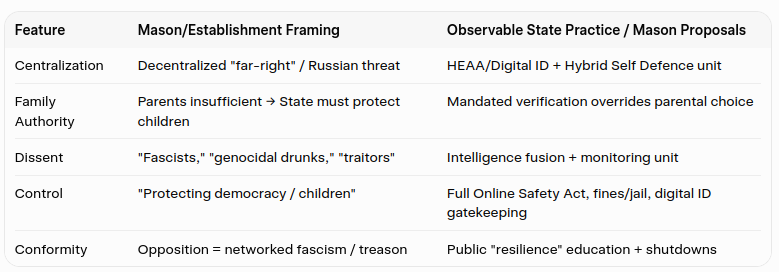
Paul Mason is not fighting a “recurring nightmare” of fascism as his book claims. His rhetoric consistently inverts definitions to defend and accelerate state expansion over family life: centralized digital control, intelligence fusion, a new civilian monitoring unit, suppression of dissent via criminal sanctions, and the replacement of parental authority with government mandates — all while demonizing working-class Britons, parental rights advocates, and skeptics as fascists, drunks, idiots, and traitors.
Based on the consistent pattern across his book, articles, and public statements, Paul Mason is best described as a vanguard technocrat — an authoritarian statist leftist who has retained the intellectual vanguard mindset of his Trotskyist past while operating under the banner of ‘anti-fascism’ and mainstream commentary.
Key hallmarks include:
Totalizing state solutions: Demanding centralized intelligence fusion, a new civilian Hybrid Self Defence Unit, mandatory digital ID infrastructure, and full enforcement of speech laws with criminal sanctions.
Pathologization of dissent: Routine labeling of working-class Britons, parents asserting sovereignty, and political opponents as fascists, traitors, genocidal drunks, or foreign dupes.
State supremacy over family and individual: Rejecting “let parents parent” in favour of government-mandated controls on information and online access.
Narrative control as governance: Treating ‘disinformation’ and cognitive onslaughts as existential threats requiring state monitoring, public re-education (resilience), and platform shutdowns.
While Mason identifies as a humanist Marxist who rejects Stalinist outcomes, his proposed architecture for Hybrid Self-Defence ignores the historical reality that centralized narrative control inevitably migrates from defensive resilience to the suppression of political rivals.
Inversion Checklist:
Claimed Value: Anti-fascism, pluralism, defending democracy Actual Practice: Labeling millions of citizens as fascists/traitors and building surveillance/resilience machinery against them.
Claimed Value: Protecting children and the working class Actual Practice: Smearing working-class protesters as hapless drunks and overriding parental authority with state mandates.
Claimed Value: Resistance to authoritarianism Actual Practice: Championing new state units for narrative monitoring and criminal sanctions on speech.
The supreme irony is that in his crusade against the recurring nightmare of fascism, Mason has become a textbook example of the very illiberal mindset that enabled 20th-century totalitarianisms: the belief that the state (guided by the correct intellectuals) must control information, families, and public thought for the greater good.
Data Sources & References
Paul Mason, How to Stop Fascism (2021).
Paul Mason, LabourList (August 2024).
Paul Mason, The New World (2026) – Hybrid Self Defence proposal.
Paul Mason, “Tony, Andy, Keir…think bigger” (Medium, May 2026).
Paul Mason Twitter/X posts (June 15, 2026).
Ofcom HEAA/Online Safety Act guidance.
UK Parliament Petition 730194 (~2.98–3M signatures).
This audit examines rhetoric versus practice using Mason’s own published standards. Readers should consult primary sources directly.